Variations are changes to the original contract work: some work is added, some is omitted, some changes specification. On Indonesian government projects they are called a CCO (Contract Change Order). Variations that are not recorded properly are one of the biggest reasons contractors lose money: the work gets done but is never billed.
Steps for handling a change
- Get a written instruction from the client or supervisor before doing the work. A verbal instruction is not enough to bill on.
- Record the reason: site conditions differing from the drawings, an owner request, or a specification change.
- Measure added and omitted quantities from the revised drawings or a joint measurement, with a take-off sheet as for the BOQ.
- Price them: items already in the contract use the contract unit price; new items use a new unit price from analysis and negotiation.
- Record the agreed prices in minutes, then a contract addendum if the value or time changes.
- Update the RAB, RAP, weights, S-curve and schedule to the new contract. Keep the old S-curve as a baseline.
Worked example
| Item | Type | Quantity | Unit price | Amount |
|---|---|---|---|---|
| Light-steel porch canopy | Added, new item | 12 m2 | Rp850,000 (negotiated) | Rp10,200,000 |
| Extra light points | Added, contract item | 6 points | Rp175,000 (contract price) | Rp1,050,000 |
| Bathroom wall tiles | Omitted | 20 m2 | Rp180,000 (contract price) | minus Rp3,600,000 |
| Net change | Rp7,650,000 |
A Rp1,000,000,000 contract becomes Rp1,007,650,000, up 0.77%. On Indonesian government procurement, additions are capped: the final contract value may not exceed the original contract price by more than 10% (Perpres 16/2018 Article 54 and its amendments). Private projects follow their own contract.
Recording it in the workbook
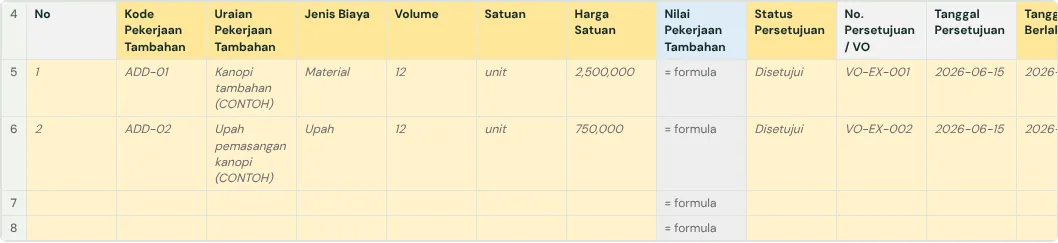
- One row per change in the Pekerjaan Tambahan tab: code, description, type (added or omitted), quantity, price, approval status and minutes number.
- Keep the status apart: submitted, approved, rejected. Only approved changes go into the contract value and weights.
- Work already done but not yet approved is recorded too, so the value still pending is visible.
Common mistakes
- Doing extra work on a verbal instruction, then struggling to bill it.
- Recording only additions and forgetting omissions, so the report shows a higher contract value than the real one.
- Pricing new items without analysis, and losing money on them.
- Not updating the S-curve after an addendum, so the deviation looks bigger or smaller than it is.
The full guide is in How to build a construction cost report that catches overruns early. It has a free template (Excel or Google Sheets) and a checker that reads your own workbook.
Ready to use the Komander agents on your projects?
When your workbook is complete, apply for a pilot: we help connect your project data to the Finance, Cost and Scheduler agents and review the first reports with you.
Send to melwani@komander.ai. Your workbook check result is included when there is one; the workbook itself is not sent.
Common questions
What is a CCO?
Contract Change Order: a contract change because work is added, omitted or respecified, recorded in an addendum.
Which price is used for added work?
Items already in the contract use the contract unit price. New items use a new price from unit price analysis and negotiation.
What is the cap on added work on government projects?
The final contract value may not exceed the original price by more than 10%, under Perpres 16/2018 Article 54. Check the current version of the regulation.
Do omissions need an addendum too?
Yes, when they change the contract value. Omitted work reduces the contract value and the weights.
References
- Perpres No. 16 of 2018 (BPK regulations database, Indonesian): Article 54 on contract changes, and its amendments